Saturday, March 21, 2015

Eostre, Spring Equinox, Lent and the International Day of Happiness

Week 4 Lenten Project
I want a life that sizzles and pops and makes me laugh out loud. And I don't want to get to the end, or to tomorrow, even, and realize that my life is a collection of meetings and pop cans and errands and receipts and dirty dishes. I want to eat cold tangerines and sing out loud in the car with the windows open and wear pink shoes and stay up all night laughing and paint my walls the exact color of the sky right now. I want to sleep hard on clean white sheets and throw parties and eat ripe tomatoes and read books so good they make me jump up and down, and I want my everyday to make God belly laugh, glad that he gave life to someone who loves the gift.” Shauna Niequist, Cold Tangerines: Celebrating the Extraordinary Nature of Everyday Life

“When you do things from your soul, you feel a river moving in you, a joy.” Rumi

“Joy is what happens to us when we allow ourselves to recognize how good things really are.” Marianne Williamson


Yesterday morning, I drew “flexibility” from the Angel Cards.  The first thing that came to my mind was doing a back bend.  I haven’t done a back bend since I was 13, and that was… hmmm a long time ago.  But, the thought of doing a back bend has been on my mind.  It was one of the things I put down in my new year’s resolution.  Why?  Back bending was an item that came into my head when I was meditating on the wishes of my heart in 2015.  Crazy?  Crazy.

Mohamad Gandhi stated that happiness occurs when what you think, what you say and what you do are in harmony.  I believe that in order for this to happen you need to be flexible.  Yesterday, my interactions with others left me with wanting to pound my head against the wall.  I wanted a project that I've been working on for six months to be done and off my desk.  However, others didn't think the same way. They wanted one more thing changed and discussed.  
After a lot of deep breathing, the only thing I could do was find humor in the situation.  I don't know if this is true for others, but it is difficult to see in the moment.     

Icing on the cake came in an e-mail my supervisor and I received on a Friday afternoon.  It was at this point I decided what I needed to do was a back bend.  Back bend modified that is.  I don't know what made me do it, but there I was bending my my body backwards over an office chair without arms or wheels.  The blood quickly rushed to my head.  I definitely saw things from a different perspective; my office space up-side-down and the ceiling.  And, it caused my supervisor and I to laugh.  The whole day we needed to just laugh.  

I think this is what spring is all about.  It is a time to step back and just laugh.  How can one not laugh, especially if you survived record level snows and polar vortex wind chills.   The yellow crocuses out in my garden they are laughing; they survived the winter months.  I think this is what Marianne Williamson meant in trying to recognize how things really are in the big picture - joyful.

***


Middle English lente springtime, Lent, from Old English lencten; akin to Old High German lenzin spring


***


Spring is like a perhaps hand
E. E. Cummings, 1894 - 1962

          III

Spring is like a perhaps hand
(which comes carefully
out of Nowhere) arranging
a window, into which people look (while
people stare
arranging and changing placing
carefully there a strange
thing and a known thing here) and

changing everything carefully

spring is like a perhaps
Hand in a window
(carefully to
and fro moving New and
Old things, while
people stare carefully
moving a perhaps
fraction of flower here placing
an inch of air there) and

without breaking anything.


Friday, February 27, 2015

Spinning back into my heart’s song - Lent 2015

2015 BEMS First Week of Lent
“It is only with the heart that you can see fully: what is essential is invisible to the eyes.” ~ Antoine de Saint-Exupery

“The best and most beautiful things in the world cannot be seen or even touched. They must be felt with the heart.” ~ Helen Keller

“Whosesoever you go, go with all your heart.” ~ Confucius


Sometimes I find it hard to remember the language of my heart.  My ears get filled with wax and I can’t hear my unique lyrics that I’m supposed to be singing into the universal song.  When this happens, I find myself being swept away by social injustices, and instead of trying to find peaceful resolution or trying to be empathetic towards the other side’s point of view; I’m angry.  The lyrics I sing clash with the ones I’m supposed to be singing about love.

It is Lenten season again.   I gave ‘giving up’ a long time ago.  I found this practice not useful in redirecting my heart down the right path.  For me, Easter and Spring are about re-birth, composting the old into something new.  Giving up chocolate, turning off the TV or becoming a vegetarian doesn’t seem to affect how I react to life’s crises or challenges.  This type of practice doesn’t unplug the wax in my ears and it sure doesn’t help me hear Motherfather Spirit any better.


This Lenten season (2015) I have chosen to get back to knowing those words on my heart.  The ones Motherfather Spirit wrote before I was born.  I want to remember those words that are to inspire me in become a better person through my actions.  Those words that make me empathetic towards others and those words that sing what is really important.   I want to get my heart back on track.  This is the re-birth I am looking for. 


I’ve been inspired this year three groups 1) Wild Woman Project – Wild Heart Wishes Meditation (February 2015) 2) Abby of the Arts - Holy Disorder of Dancing Monks, and 3) Findhorn Inspiration website.

Serenity (O Magnum Mysterium) - Ola Gjeilo - this music makes me very contemplative.  


Spinning back into my heart’s song: A daily ritual during Lent:


Materials Needed:

  • Paper with a spiral design or you can make your own. 
  • 40 plus Premade circles.  I made mine tracing quarters onto paper.  You can make yours bigger or smaller. 
  • Magic markers, pencils, ink pens
  • Glue or paste
  • Scissors
  • Small votive candle
  • Angel cards or Findhorn Daily Inspiration that includes an Angle Card or opening spiritual writing and identifying on word describing its message.
  • Journal

2015 BEMS - Openness
Directions

  • Light the candle and open your heart.
  • Pull an angle card and read it.  Say the word out loud.  Write down in your journal what you think this word means spiritually or why it should be written on your heart.
  • Next, read the word again.  Say the word out loud.   Ask for guidance from Motherfather Spirit.  Meditate on the word.  Example: Open   These are the types of questions I ask myself: 1) What does being open mean to me as a spiritual being?  How do I show others that I’m open?   How do I react to hearing something new – open or closed?  (NOTE:  The CCWWW way is different for each of us.  You have equally interesting questions to ask yourself.)  Allow some time to journal on this word. 
  • Contemplate what the word means to you in a symbol.  Doodle or draw in your journal.
  • Now, reflecting back on your journal, draw or write something that will remind you of this word in one of the pre-made circles.  Color it in.  (NOTE:  A CCWWW doesn’t judge their art against famous artists. This is a spiritual art and speaks from your heart.)
  • Cut out the circle and paste it on the spiral path.
  • Thank Motherfather Spirit for giving you this message about your heart.  Extinguish the candle. 
  • I tend to do this ritual in the morning and carry the small circle around.  The circle reminds me of the word that is etched on my heart.  In the evening I glue it onto the spiral. 


Monday, February 2, 2015

Imbolc and Migrating Swans


Two Swans (Wallpaper) by Walter Crane 1875
Initiation is a process by which "we try to develop ourselves not that we may become great and wise, but that we may have the power and knowledge to work for humanity to the best effect." ~ C.W. Leadbeater

“Women and birds are able to see without turning their heads, and that is indeed a necessary provision for they are both surrounded by enemies.” James Stephens

“It is the women who make life endurable for each other, give physical affection without causing pain, share, advise and stick by each other,” Adrienne Rich


This Imbolc evening,  I witnessed a beautiful sunset driving home from work.  The sky had pinks, yellows blended together with a touch of magenta.  It is a joyful sight at this time of year in Ohio.  When I finally reached my home, getting out of my car, I heard honking above.  Looking up, I saw a flock of geese flying in V formation headed towards the north.  The moment was a hopeful after a week and early morning of icy rain, slush and forever-gray haze.   It was a taste of hope reminding me that spring is near.          

This year CAYA Coven’s focus is on women free as birds.  My thoughts have centered on Brigid, Imbolic being her feast day.  The white swan and a bird’s foot are two of her symbols.  There is also the Scottish tale of the goddess Cailleach.  On Imbolc eve if the day is bright and sunny, Cailleach gathers firewood if she wants the winter to last longer.  If the day is gray and hazy than Cailleach sleeps-in.  This makes her firewood run out sooner and in turn make the warm weather come sooner.   She too is associated with a giant bird carrying sticks in her beak.  Some feel she is Brigid in crone’s form ruling winter until spring.    


###

The Simple Dark

by Luci Shaw

Black birds slice their evening patterns—

long curves in the sky. Everything

is drawing down into shade.

But the dark, which is at first so simple

is not simple. Away from the farmhouse

with is slits of yellow, the monochrome

develops like a print in the chemical bath.


The unbroken velvet swims

with complications so subtle that

seeing and hearing must take their time

to know. The shadow purples,

the dusk intricate with crickets. The sky

infested with pricks of light.

My whole body an ear, an eye.


### 


In my yearlong exploration of women’s friendship, what I’ve discovered so far is an emphasis of giving and receiving.  Friendship is about staying in touch through notes, phone calls and coffee.  To be a friend means to stick with this dear person by celebrating the joys and holding their hand during the sorrows.  This doesn’t mean that you have to agree with everything they believe, it means you can agree to disagree, but still respect each other.

I believe people can learn a lot from observing nature, especially from swans and geese.  “Scientists have found that birds position themselves and time their wing beats so perfectly, that according to aerodynamic theory, they minimize their energy use. “  (note: a great video showing birds flying)  Each bird creates an uplift for the one behind.  This allows the flock to fly further than one going solo.   

Geese like a great friend, honk from behind cheering those ahead to keep up their speed.  Geese believe in shared leadership; all get their chance in the key position.   When a goose gets tired, someone is there to step up and take the lead.  This allows the tired goose to fall back and rest. 

Geese are caring.  When one gets sick or wounded and falls away from the flock, two others will fall out of formation to be with that bird.  They will not return to the flock, instead they stay with their fallen friend until they are able to fly or it dies. 

"We shall lift each other up" by Circle of Women

Monday, December 8, 2014

Adrienne Rich's Vision


Adrienne Rich
I’ve been plowing through journal articles written about women’s friendships.  I’ve noticed that there are many more written about the problems women have being in friendship with another women and the numerous ways women inflict pain.  From a spiritual standpoint, this seems to affirm the numberous stories I’ve heard about how women in circle act towards other women.  The behavior includes: being cruel, talking behind another’s back or not acknowledging another.  When I hear these stories, it rubs me the wrong way.  It is in conflict to what I believe is supposed to happen in circle and is probably the main reason why some women choose to go solo - myself included.  Who wants to be in a group where you are rejected, ignored, experience the silent treatment, betrayed, ostracized or pressured to leave the group?  And, if you refuse to join into this behavior then you get the backlash of this behavior.  

Adrienne Rich wrote an essay in 1980, “Compulsory Heterosexuality and Lesbian Existence.”  The essay has been analyzed, reviewed, and pulled apart by numerous scholars, feminists and etc.  I see Rich’s essay as a vision statement for the future.  Who wouldn’t like a circle or a workplace where you could say, “it is the women who make life endurable for each other, give physical affection without causing pain, share, advise and stick by each other,” (Rich).  I see Rich’s vision statement up there with Martin Luther King’s dream of a world without racism.  

I think the question becomes how do we achieve this future? What do we need to do to make it happen?


###


At Willard Brook
by Adrienne Rich
November 18, 1961


Spirit like water
moulded by unseen stone
and sandbar, pleats and funnels
according to its own
submerged necessity —
to the indolent eye
pure wilfulness, to the stray
pine-needle boiling
in that cascade-bent pool
a random fury: Law,
if that's what's wanted, lies
asking to be read
in the dried brook-bed.

Tuesday, November 11, 2014

Women's Friendship

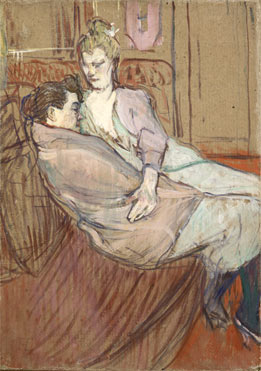
The Two Friends by Toulouse-Lautrec (1894) 
“Friendship is born at the moment, when one man says to another: “What! You too?  I thought than no one but myself…” C.S. Lewis, The Four Lovers

“What is a friend?  A single soul dwelling in two bodies.” Aristotle

“True friends are always together in spirit. (Anne Shirley)” L.M. Montgomery, Anne of Green Gables

               
I’ve been given the okay for my thesis topic: women’s friendship shown in literature.  Specifically, I will be looking at positive friendships in contemporary literature that are not mean girl in spirit and can pass the Bechdel test (the novel has to have at least two female leads that talk about something other than men and getting a partner).  I’m interested in how authors show intimacy and conflict between friends.

I’ve been given many recommendations of favorite girlfriends books to read that have been published after 1985.  The books seem to cluster around: two friends, a group of friends, intergenerational friends and inter-racial/culture friends.  I’ve also noticed that many of these books haven’t been given the nod to be called literature.  In fact, not many books about women’s friendship have been given this nod.  Yet, these books seem to land and stay on the NYTimes bestsellers list and many have become popular movies (i.e., The Help, Beaches, The Secret Life of Bees, Fried Green Tomatoes, Divine Secrets of the Ya Ya Sisterhood, Where the Heart Is).  NOTE: This is my observation and I haven’t analyzed these books for elements of literature.

Over the next seven months, I’m going to share what I find about women’s friendships.  It is my hope that what I write in my blog will help inspire my final essay.  Brainstorming, I plan on looking at the topic from a historical standpoint: Emma and Jane Eyre’s friendship are worth looking at; reading what Virginal Woolf has to say and other female writers.  Finally, I want to look at the spiritual aspect of friendship along with what psychology, feminist studies and sociology has to say. 


Saturday, February 15, 2014

Devotion – a place where all forces come together.


"At Eternity's Gate" by Vincent Van Gogh  (1890)
“Drink your tea slowly and reverently, as if it is the axis on which the world earth revolves - slowly, evenly, without rushing toward the future. Live the actual moment. Only this moment is life.” ~ Thich Nhat Hanh


“I understand our mornings can be busy; however, if we cannot make time for God now, then when?” ~ Ashley Ormon, God in Your Morning


It’s been another rough week as a mom in Buckeye Land.  My heart has been heavy.  Words have been exchanged and feelings have been hurt on both sides of the dinner table.  This has also expanded outside our home too.   An unexpected task has now appeared on my desk and my heart hurts for a son because a young woman said yes and then stood him up.  My feelings and emotions are all turned-up-side- down. 

In situations like this I set off to find my grounding point.  For me, it is the place where all the forces come together within me.  That point where I know I’m connected with the divine spirit.  When I’m there; I’m balanced.  I can put the dark emotions into a perspective.  There, I know that I will survive and can move on.  The divine drives my emotions and no other forces.

Getting to that place and finding that place takes work.  It isn’t something you can buy at the store or an herbal spell you brew up.  It comes from daily practice of being devoted to MotherFather Spirit.  I have discovered the more I’m devoted to practice the easier I can come to that middle point where I'm not at where my emotions are out of control and the world looks dark and without hope.

A daily devoted practice to me means prayer, meditation, yoga, knitting, walking, exercising on the stationary book, writing, drawing mandalas, and etc.  I do it alone and I do it in fellowship.  My practicing time isn’t about calling the spirit for a 911 “help me request,” but putting in the thanks and joyful noting or citing WOWness.  I believe you need to see both (i.e., 911 and joy) in order to find your balancing point and center.  The world isn’t just about crisis; it has the joys too.  If you can see both, it helps you put things into a calmer perspective.     
          

~#~ 


Over Cherry Blossoms
by Shuntaro Tanikawa


Over cherry blossoms

white clouds

over clouds

the deep sky

over cherry blossoms

over clouds

over the sky

I can climb on forever

once in spring

I with god

had a quiet talk.


~#~

If you haven’t ever prayed before or don’t know how to start to find your center.  I got this from a women’s meditation retreat back in the 90s.  The key was meditation or prayer help FADES the crisis.  The FADES is a mnemonic describing things to consider when you pray to MotherFather Spirit.    


F= Free and Formed

A = Alone and Assembled

D= Desperate and Delighted

E= Explosive and Extended

S= Spontaneous and Scheduled

My instructor at this retreat was animate that prayer wasn't about sitting still in a room.  This was the first time I heard this.  She said prayer needs to be done while you are singing with friends; waiting at the check-out line when you see an act of kindness; or when you are pondering out what word should come next in your "blog."  She stated that the "Now the lay me" and "God is great" ritually at dinner is fine for a starting point - but prayer should be done on the seat of your pants.  You should think of prayer as a day long conversation with MotherFather Spirit.  


Tibetan Wind Horse Prayer

(Tibetan prayer flag is 'Lung ta', meaning 'Wind Horse')


As Wind carries our prayers for Earth and All Life, may respect and love light our way.

May our hearts be filled with compassion for others and for ourselves.

May peace increase on Earth. May it begin with me.


Saturday, February 8, 2014

In the spirit of Starhawk….. Authors as Social Observers: the effects of childhood trauma


Authors have been called social observers for their keen ability to see injustice and translate them into stories that make readers stop and ask questions.  Their stories have a way of punching through our mental walls and help us see things afresh.  Some authors have been able to uncover health issues that are a result of social conditions often ahead of research.  Jean Rhys 1966 novel Wide Sargasso Sea is one.  Her story relates a current leading topic for research in preventing chronic mental and physical health outcomes by looking at traumatic experiences during childhood. 


                Rhys offers a prequel to Charlotte Bronte’s novel Jane Eyre and finally gives Antoinette (Bertha) Mason Rochester her voice her story.   In Bronte’s novel, Antoinette was described as Rochester’s first wife who was insane and kept locked in the attic.  We learn from the story that Antoinette is a white Creole woman living in British-owned Jamaica after the emancipation of slaves.  It is through Rhys’ narrative Antoinette shares her experiences during childhood and the first years of marriage to Rochester.  Rhys identifies the consequences of childhood trauma, racism and gender oppression on Antoinette’s mental health and that ultimately leads to her suicide.       


                Thirty years after Rhys’ novel, American researchers began documenting the outcome of repeated traumatic events during childhood.  Neurobiologists took the research a step farther showing how trauma changes the neuropath ways developing brain (i.e., birth -25 years of age).  Untreated, the trauma increases a person’s risk for depression, drug and alcohol abuse and suicide (Felitti, 5).  In Antoinette’s case, she describes the dysfunction of her childhood household.  Her mother was raising her brother and her alone following the death of their father to alcoholism (Rhys, 473).  The cumulated stress of managing a plantation without any skills, having a lack of money, and having a son with Cretinism (i.e., congenital hyperthyroidism) her mother “grew thin and silent, and refused to leave the house” (466)  and begins to “talk to herself” (467).   When Antoinette tries to approach her mother, she is pushed away coldly and told to leave her alone (467, 485).  Her mother remarries and the step-father brings stability into the home until it is burnt by a mob.  Her brother dies as a result of the fire and her mother develops a severe psychosis (480).  Her step-father sends Antoinette to live at a convent.     Antoinette describes how she copes with being neglected: spending time in the kitchen, eating alone and being alone in the woods (471, 477).   She also relates that she didn’t feel safe as a child and had nightmares (478, 488, 493).  It is clear that Antoinette herself is beginning to some mental reaction responding to this trauma and dysfunction by disassociating.                                   


                It is important to understand how Antoinette racism impacted her life on Jamaica.  Both she and her mother were considered white Creole and a minority community living on the island.  She is born into a family that owned slaves and now despised by the emancipated black Jamaicans.  At the same time, the arriving English to the island considered white Creoles as not European born.  Antoinette is repeatedly called “white cockroach” (469) by the blacks and “white niggers” (470) by the English.  She and her mother had supportive place in society.  Antoinette’s first violent experience of racism occurred when her mother’s horse was poisoned by “black people” (465).  She befriends Tia, a black girl and they play together.  However, Tia steals her money and dress (470).  It is Tia who throws a rock at her from the black mob who burned down their house (483).   Rochester her husband, describes Antoinette as “beautiful, but” and that she has “long, sad, dark alien eyes.  Creole of pure English descent she may be, but not English” (496).  Antoinette continues to experience acts of racism after marrying him.  After being called a “white cockroach” by a black paid servant, Antoinette secludes herself and stating “I wonder who I am and where my country is and where do I belong and why was I ever born at all” (519).  Rochester responds that she is over-reacting.  Antoinette reaction is to disconnect from what is happening around her by falling back on childhood coping mechanisms.  


                Within less than two pages, Rochester already describes his wife as “not English or European either” (496) and before reaching their honeymoon cabin readers realize he was paid 30,000 pounds to marry her (498).  However, Rochester admits he doesn’t love her, but he loves her money and property that she came with.  His behavior isn’t uncommon for a man of his day.  Under English rule at the time, a man assumed all money and property and rights of his wife.    He begins to oppress Antoinette further by withholding sex and calling her another name, Bertha (523).  Rochester believes the stories of her half black brother and refuses to listen to Antoinette’s version of the story about her mother and brother.  Antoinette finally realizes Rochester doesn’t love her and wants only her money; she is stuck because of the law.  In England, Rochester sedates her and locks her up after she asked someone to help her leave him on their voyage (568).  Believing her brother’s story, he labels and treats her as insane.  Antoinette describes looking into the mirror and watching Antoinette “drift out of the window with her scents, her pretty clothes and her looking glass” in her locked room (568).  She explains how she is able to cope by dissociating from reality.  She tries to save herself by setting fire to the house and committing suicide done in a fashion that reenacted the fire was set to her childhood home.


                 Wide Sargasso Sea is able to describe what it was like for woman living as a postcolonial white Creole minority living under strict gender rule.  What makes the book remarkable is Rhys’ observations of how this can affect one’s mental health.  Many of her descriptions of how Antoinette and her mother react and coped with trauma had not been studied in the field of psychology.  In the 1960’s mental illness, child abuse and neglect and domestic violence were taboo and uncomfortable topics in both the home and in the medical community.  Still, Rhys chose to give us an alternative view to why Bronte’s Bertha ended up in the attic room and ultimately committed suicide by showing us the cumulative effects of trauma.  Her work was one of many authors who helped the public question treatment of those with mental illness.    


References


Bicknell-Hentges, L, and Lynch, J.J. “Everything Counselors and Supervisors Need to Know About Treating Trauma.” American Counseling Association Annual Conference and Exposition. Charlotte, 19 March, 2009. Presentation.  Web. 13 Dec. 2013.


Felitti, Vincent J. “The Relationship of Adverse Childhood Experience to Adult Health: Turning gold into lead.” Z psychsom Med Psychother. 2002. 359-369. Print.


Mardorossian, Carine M. “Shutting Up the Subaltern: Silence, Stereotypes, and Double – Entendre in Jean Rhys’s Wide Sargasso Sea.” Callaloo. 1999. Web. 13 Dec. 2013.


Rhys, Jean. “Wide Sargasso Sea.” Jean Rhys The Complete Novels W.W. Norton & Company: New York. 1985. 465-574. Print


Wolfe, David A., Crooks Claire C., Debbie Chiodo, and Jaffe, Peter. “Child Maltreatment,Bullying, Gender-Based Harassment, and Adolescent Dating Violence: Making the 
Connections.” Psychology of Women Quarterly. 2009. 21-23. Print.