Saturday, January 25, 2014

Check out the blog party

2 Bags Full

What a wonderful way to spend a Saturday after finishing up homework and in-between baking cookies and cleaning.....especially when it is cold and snowing in Buckeye Land.  


Friday, January 24, 2014

2014 Year of Expecting a Miracle: creating a personal compass BOOKLET

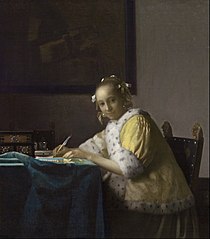
"A Lady Writing a Letter"
by Johannes Vermeer (1665)
"Never put your faith in a Prince. When you require a miracle, trust in a Witch.” ~ Catherynne M. Valente, In the Night Garden


"Miracles are like pimples, because once you start looking for them you find more than you ever dreamed you'd see.” ~ Lemony Snicket, The Lump of Coal


"And now we step to the rhythm of miracles.” --from The Light, That Never Dies” ― Aberjhani, Elemental: The Power of Illuminated Love


So I’m back at writing this blog as a creative and spiritual outlet to graduate school and life in general. As you may know, I’m part of the Wild Woman Project and our New Year’s kick off project was to create a little book. This booklet is to be packed with: a prayer(s), wishes, affirmations and feelings – our intentions for the coming year. Additionally, the booklet would be our focus for the New Year or act as a compass to guide us.


The first step in creating this book – was to think of a theme we wanted for the year. I’m not one for dreaming up themes so I pulled from the Goddess Oracle Deck (Virtue) and “Mother Mary’s Expect a Miracle” came up for me. Without any hesitation, I wrote down as the title and theme of my year “2014: The Year of Expecting Miracles.”


Why not miracles? The world needs more of them and the world needs more of us to observe them. And, the world needs more of us to assist in making them happen.


~#~

Our booklet is to be used like you would affirmation statements. You read it front to back daily to keep you on track. (I’ve clipped it to my datebook and it is the first thing I see in the morning.)

The French pharmacist Émile Coué, in the late 1880's is considered the first person who wrote about the use of affirmations. In his practice, Dr. Coué had his patients daily recite the phrase "Every day in every way I'm getting better and better." He believed that this autosuggestion would assist people in healing themselves.

I learned about affirmations from my teacher Nettie Morse. She was a student from the Louise Hay’s camp. The affirmations created are to help you change negative beliefs and scripts you have about yourself. They help you see yourself in a more positive light.   

~#~

The second page of the Wild Woman booklet was to answer the question “What would I like to build this year?” During my New Moon meeting with my Wild Woman Friends, again I was being opened to MotherFather Spirit’s suggestions. A thought that popped into my head was about the lack of balance I’ve been feeling lately around being a good mom, being an advocate for sexual and intimate partner violence survivors and being graduate student and the lack of building in relaxation time. 

I admit my house has transformed into clutter heaven. My yoga and walking have been kicked to the curb, because I haven’t quite found the balance yet with these new graduate school requirements. And, I’ve been going through the motions of being a CCWWW and being silent on this blog. 

Once again, MotherFather Spirit is right on the money for what is essential for my sanity, spirituality and physical health for my heart. 

So on page two, I wrote “Building in relaxation time.”

~#~ 

Three incidences have occurred since creating and reading my book daily. 1) I was asked to join someone at Yoga class, 2) I found out that Yesherabbit Coven’s theme is centered on miracles, and 3) Eileen Cady’s daily inspiration.

Maybe these coincidences have been occurring all along, but I believe I’ve been so caught up in stuff and not recognizing them. I look at them as mini miracles or the miracle of messages that I’ve not been paying attention to.

With that in mind: I’ve recorded these occurrences on page 5 of my book.  

~#~

Eileen Caddy’s daily inspiration (1/15) – I chuckled – it was so right on. 

“Why not relax? Let go and let Me take over, for the more stress and strain there is in your life, the less you get done. Why not let yourself flow with nature, flow with the tide, and do what has to be done quite simply, naturally and joyously? Why not enjoy life, instead of going through it with grim determination, forcing yourself to do this, that and the other without any joy or love? Life is wonderful when you are in harmony with it and cease resisting anything. Why make everything complicated for yourself? Why not make today a special day, and see the very best in everything? Give thanks for everything. Enjoy everything as it should be enjoyed. I want you to enjoy life. Start off by seeing the beauty of nature all around you, and you will find that one wonderful thing will lead to the next, until your whole life is one of wonderment and joy.” 

Relax? I’ve just finished my second packet for graduate school and relax has been the word of choice. Thus I’m chuckling again at the above quote. 

Why? I have found that writing the two critical essays is a forced task for me. Each word generated is labor intensive like finding the right word for a crossword puzzle. Don’t get me wrong, I love reading the assigned novels and looking at writing concepts and themes, but transcribing these ideas down onto paper has been stressful and not a joyful or flowing experience – like say writing in my blog or writing a poem.

I wonder can one do an interpretive dance to help create a critical essay. I believe that would be relaxing. I took up an invitation from a friend to join her in yoga – that was relaxing. 

I wonder if the miracle this year is to learn how to be more relaxed writing these essays. 

~#~  

Create your own booklet for the year with the Wild Woman Project:

Take a piece of 8.5 inches by 11 inches paper and cut it in half. Stack the two piece of paper together and fold in half. These are the pages for your book. 

Cover Page – theme by picking from the Goddess deck  

Page 1 – create a prayer to read daily that will help you focus on your theme and help you during the down times. 

Page 2 – “This year I will build____” 

Page 3 – “This year I feel ____” 

Page 4 – “This year I’m open to ____” 

Page 5 – Write down the dates you notice your theme happening. 

Sit with your ideas until January 30, 2014. Feel free to decorate the book and make it your own. I went through cards sent to me this past year and have added decorations. The booklet will be dedicated on the 30th the new moon.


Tuesday, January 14, 2014

Ordinary Women as Agents of Social Change: The Mirabel Sisters - The Butterflies


In Carl Theodor Dreyer’s silent film The Passion of Joan of Arc (1928), Joan sits in her prison without helmet or sword.  The film portrays her as an ordinary young woman.  Dreyer humanizes her by filling the screen with close-ups of her face.  We see Joan wrestle under the pressure of the inquisition.  Her eyes show that she knows her path leads to being burned at the stake.  But, she maintains the conviction of her faith.  Stories have been written about heroic women such as Joan, but for the most part they come across as having super human qualities with helmets and swords unlike ordinary women.  The majority of women who have been agents of social change have been silenced because of this ordinariness

In the Time of Butterflies, Julia Alvarez writes a novel based on fictional events.  It is told through the different voices of the four Mirabal sisters (i.e., Patricia, Dedé, Minerva, and Maria Teresa) also known as Las Mariposas (The Butterflies).  Each sister tells their story of how they became involved in opposing the Dominican dictatorship of Rafael Trujillo (1930-1961). In the end of the book, Trujillo ordered the assassination for three of the sisters on November 25, 1960 alongside a mountain road between Puerta Plata and Santigo.  The outcome of their death and the continued voice of Dedé, their surviving sister ultimately led the Dominican people to overthrow Trujillo.  Alvarez goes beyond this historic event by providing stories about their childhood, sibling jealousy and personal dreams.  Her use of multiple narrators gives voice to each sister showing they were unique and ordinary women, but not a mythic figure.  

            Alvarez is deliberate in separating the sisters’ voices by using different points of view.  We are introduced to Dedé as she is being interviewed about her sisters.  Written in third person, her actions emphasized she wants time for herself away from being care taker of her family’s legacy and underground movement’s stories.   She is blunt to the interviewer saying: “What is it that you want to know” (7).  Dedé wants the interview to be quick, but knows it can’t be.  Patricia story is written in first person internal monologue.  She is the most religious of the sisters and her voice brings forth her struggle with God.  Patricia’s story moves towards her death, it becomes her confession to the readers and God.  Maria Teresa shares her story through her diaries.  The first diary, a First Communion present, is written from a nine/ten year point of view.  There are short paragraphs with unending sentences.  These beginning entries include drawings like her new shoes and sister’s swimming suit (36) and her later diaries contain bomb making diagrams (144) and the prison layout (229).  She keeps a diary while in college and again during her imprisonment as a political prisoner.  The entries writing style changes as she grows older.  Maria Teresa is chosen to be questioned by the Organization of American States Committee on Human Rights Abuse in prison.  Trujillo believes she will be silent in order to save her family members, but she secretly passes her journal writings to the interviewers (254).  Minerva, the most political sister, writes in a personal essay format.  The essays are given a title such as: “What do you want, Minerva Mirabal? Summer” (84) or “House Arrest” (257).  Together her essay collection feels like a personal memoir by sharing events that have influenced her.  Alvarez use different point of view emphasizes the sisters’ different personalities. 

            The novel portrays the sisters’ personal struggles between work and romance are similar to contemporary women.  Patricia and Dedé choose a more traditional path for women.  They marry after graduating from high school and begin having children.  Patricia is a farmer’s wife while Dedé helps run both her father’s and husband’s business using her financial skills.  Minerva is hesitant to get involved with men.  She initially believes that men will interfere with her dream of being a lawyer and her leadership position in the resistance.  However, she finds and marries a man who respects and encourages these qualities, whereas Dedé’s husband becomes more restrictive in what she does.  Maria Teresa follows Minerva’s path by going to college and being involved in the underground.  However, Minerva meets a certain man in the underground and she sets out to win his heart.  Both women have children, like their older sisters.  When Minerva and Maria Teresa are in prison it is Dedé who returns to help take care of her nieces and nephews.  Ultimately, it is her that becomes a mother for all 10 children following her sisters’ deaths.  Alvarez shows that the sisters struggles with defining motherhood and work isn’t any different from what modern women experience. 

The strength of the novel lies in the different reasons why each sisters chose to become agents of social change.  Minerva writes in her essay “Complications” about her friend Sinita.  Sinita describes the assassination of all the men in her family and how the convent school has allowed her to attend for free.  Minerva writes, “I was shaking by the time she was through” (17).  It’s the first time she hears that Trujillo was anything more than the beloved President.  It is through Maria Teresa’s dairy we learn that 18 year old Minerva and several classmates have been attending resistance meetings.  Maria Teresa questions her sister wanting to be involved in something so dangerous; Minerva replies: “She wanted me to grow up in a free country” (39).  Maria Teresa joined the summer following Minerva’s graduation from law school.  Maria Teresa had witness compounding events that Trujillo inflicted against her family.  Specifically, he had tried to make sexual advances towards Minerva.  The family’s response led to the imprisonment of their father and his death.  The event that pushed Maria Teresa was at Minerva’s graduation from law school.  Trujillo let Minerva study law, but did not give her the license to practice (138).  Patricia joined after witnessing a massacre by the guardias (national army) during a religious retreat.  Patricia saw herself as a mother in the eyes of God.  When she witnessed a young boy seeking sanctuary of the church being shot, she saw her own sons and all Dominican sons.  Patricia and her husband joined with their sons to fight justice in accordance to God’s laws along with many Dominican Catholic clergy.  Dedé was last to join.  The assassination of her sisters gave Dedé the strength to stand up against her husband and finally become involved in the “trouble Minerva and the others were cooking up” (149).  She stood by her sisters’ caskets and at each military stop she would shout “Assassins! Assassins!” (308).  She became vocal advocate to speak the truth against the Trujillo regime and now is the care taker of the stories for us to remember.  Alvarez reinforces through the sisters voices that there are many reasons how people find the courage to speak out against injustices.

The Mirabel sisters are viewed in the Dominican Republic as martyrs for freedom.  In the Time of Butterflies, Alvarez shows us four ordinary women who lived under a dictatorship and why they each chose not to accept the way things were.  She does this by humanizes them and having each sister share their stories as a sister, mother, wife and daughter.  As multiple narrators, they bring different perspectives of how to work towards justice and become closer to us.          


Reference:

Alvarez, Julia. In the Time of Butterflies.  1994. New York:Penguin Books, 1995. Print.

Harper, Rachel. “Rules of the relay race: Writing a novel with multiple narrators.” Spalding           University. Louisville, KY. 22 Nov. 2013. Fiction Lecture Fall Residency 2013.

Ink, Lynn Chun. “Remaking identify, unmaking nations: Historic recovery and the            reconstruction of community In the Time of Butterflies and The Farming of Bones.”    Callaloo. 27.3 (2004): 788-807. Web. 2 Dec. 2013.

“In the Time of Butterflies: Julia Alvarez.” Big Read. National Endowment of the Arts, 24 Nov. 2013. Web. 6 Dec. 2013.

The Passion of Joan of Arc. Dir. Carl Theodor Dreyer.  Société Gėnėrale, 1928. Film.

Saturday, October 12, 2013

Random thoughts about Domestic Violence Awareness Month

  • Nearly 1 in 5 women (18%) and 1 in 71 men (1%) have been raped in their lifetime.  
  • Approximately 1.3 million women were raped during the year preceding the survey. 

  • One in 4 women have been the victim of severe physical violence by an intimate partner, while 1 in 7 men have experienced the same. 

  • One in 6 women (16%) have been stalked during their lifetime, compared to 1 in 19 men.
Statistics from - Centers for Disease Control and Prevention’s (CDC) National Intimate Partner and Sexual Violence Survey (NISVS) 2010

Breast Cancer Awareness Month 


This month is greatly out colored by the sea of pink.  The purple has been lightened with white and a tinge of red.  Basically it becomes a month - hot pink in color. 

I feel that I’m pressured to choose breast cancer over domestic violence.  I’m enticed to buy pink this and that at the grocery store check out and from the pizza shop.  Even my sports teams are getting into the spirit - goalies are wearing the same shade of pink as the soccer balls and American football players are having pink dying parties for their socks.  Somehow, breast cancer has become more palatable to talk about even though interpersonal violence is more prevalent. 

~#~

Amethyst – the purple quartz crystal – My Grandmother’s Birthstone

Amethyst has been used to strengthen the immune system and help heal imbalances of the respiratory tract and skin.  It is said to have meditative and calming effect on the individual by working on the emotional, spiritual and physical planes.  It is also has been used to help heal grief and pain from the past.  Amethysts have helped the wearer become more flexible and cooperative with those around them. 

It seems like a good stone for those working and healing from domestic violence.  

~#~

Minimizing, Denying, Justifying, Blaming – I feel like we tend to think that these 4 words are only what batter, rapists, sexual harassers and bullies do with regards to their behavior, however I believe bystanders use them too.

This past week I've felt like I’m living in another universe.  On Sunday, I noticed a signs for a candidate who is running locally for school board.  I kept thinking:  “You have to be kidding.”  (Note: this is the PG version of my thoughts).  The candidate had a romantic relationship with his student for three years.  I kept thinking, have people forgotten? 

The responses I've gotten so far:  “Well, she was 18 when it started.”  “He was in his twenties and near her age.”  “It takes two.  It isn't as if she was a minor.”  “I don’t think she was in any of his classes, just going to school there.”  “He had to give up his teaching license and his career.”  “He’s had to give up a lot.”

Let me back-up.  As a teacher (or name your licensed professional – doctor, police officer, nurse, social worker….), there are ethical guidelines that you are to follow.  The teacher-student relationship is an unequal power and status distribution.  The teacher has a hierarchical power over the student based on their role in the school and in the community.  Students are to obey and respect teachers.  Teachers enforce the rules of the school to all the students, not just the ones in their classroom.  Teachers are also required to treat and evaluate all students fairly. 

Based on this power dynamic – how can a student give true consent towards a romantic relationship?  How can a teacher treat and evaluate a student fairly who they are dating?

To my community – As bystanders, I’m deeply concerned about the lack of clarity in why dating a teacher is wrong.  And this being the case, how can we elect someone who didn't understand the ethical guidelines into a position where they have to enforce these rules?  Who will be providing the oversight over him?  Clearly us bystanders aren't on top of this.

I’m hugging my Amethyst.

~#~

What you can say to a friend experiencing violence
  1. I am afraid for your safety.
  2. I am afraid for the safety of your children.
  3. You deserve to be safe. 
  4. I believe you and I am sorry this has happened to you.
  5. I am here for you when you are ready to leave.
  6. You do not deserve to be abused.
  7. No one deserves to live with violence in their home.
  8. There is help available.  Can we call this number together?
  9. You are not to blame.

~#~
Telephone numbers to share
National Domestic Violence Hotline -  1-800-787-3224  1-800-787-3224 (TTY)
National Rape Incest Abuse National Network - 1-800-656-HOPE
Click to Chat With an Online Representative


Tuesday, October 8, 2013

Sharing Abundance - Working from your heart.


“Life and death are not opposites. Death is integral to the whole/holiness of the sacred web of all that is. In this experiential workshop with slides, movement, trance, song and sacred theater and whatever arises in spontaneity/gaiety we will explore a way of viewing death that actually comes from the realm of our pre-patriarchal ancestors. Very little is known or taught about how our early ancestors lived, and in this space together we will learn from them and bring forward a much needed shamanic integration about life and death for body mind and spirit. We will also learn what it means to “midwife” death in our current time and how to transform fear about death into pure love."  Leslene della-Madre


“With tears and prayers and tender hands, Mother and sisters made her ready for the long sleep that pain would never mar again, seeing with grateful eyes the beautiful serenity that soon replaced the pathetic patience that had wrung their hearts so long, and feeling with reverent joy that to their darlings death was a benignant angel, not a phantom full of dread. “ Louisa May Alcott, Little Women


Death can be looked at as both the end and the beginning.  I see it as part of the sacred cycle of breathing and expiring, combining and recombining, gathering and giving away.  However, I tend to think we moderns like the birth process better than the death process.  We can’t see any joy when a spirit leaves us as our ancestors did. 
 
Many of the books I read as a teenager set the stage for death.  The Victorians didn’t seem to have the same mindset as we moderns do.  It wasn’t usual for the dying to be in bed surrounded by loved ones and friends.  There were prayers and poems read, final kisses and words said all providing the dying one the support they needed to reach the place between the earthly plane and the divine.  The gatherers were equal in volume as the gatherers at a birth.
 
This past Sunday I popped into my favorite bakery for a muffin and coffee.  The baker had saved me a pistachio one; he knows it’s my favorite.  When he went to pull it out of the case, he broke down with a deep sigh.  Clearly he was upset and then quickly apologized.  He told me he can’t look at the chocolate muffins without crying and thinking of his friend. 

 
These past days have been rough for him.  He told me his tenant who became his friend passed.  The chocolate muffins were his favorite.  He can’t not look at the muffins and see his friend.

 
The baker went to check on him and found him on the floor.  He had suffered a stroke.  The baker quickly called the squad.  His older friend was admitted to the hospital.  When his grand-daughters arrived at the hospital, they demanded all his things.  The baker gave them his friend’s keys and wallet.  The girls disappeared.  

The baker stayed with his friend.  Holding his hand and walking with him to the crossroad.  The baker believed – it’s what friends do.  He was sad in for his loss, but also sad that the grand-daughters were there to also say goodbye.   

When the baker returned home to his rental building, he found that his friend’s apartment had been raided by the grand-daughters.   They were looking for material things he didn’t have.  The baker explained to me – they didn’t realize the wealth their grandfather shared abundantly were in acts of kindness over coffee, conversation and chocolate muffins.

The baker was a man who was working from his heart.

~#~
Deep Peace to You
Deep peace of the running wave to you.
Deep peace of the flowing air to you.
Deep peace of the quiet earth to you.
Deep peace of the shining stars to you.
Deep peace of the infinite peace to you.
- Adapted from ancient Gaelic runes
 
This is John Rutter’s music set to the ancient words with the Edinburgh Singers. 
 
~#~
 
My friends from Europe have asked me what is going on here.  I’m asking myself the same.  What is going on here?  Why can’t my government get along?  As a CCWWW, I know that things reflect each other.  My government only mirrors what is happening in the general population. 

 
I think we are not working from our hearts.  We have lost sight of the abundance we have and focus only on what we don’t have.  Many of us are living from scarcity.  When we work from scarcity it is okay to not get along and put others down.  It is easy to shame, laugh at or ridicule someone who‘s not doing as good as we are.  It becomes easy for us to climb over another to get “X.”  We have lost sight of compassion and love. 

Think about it:  How do you look at a homeless person on the street?  How do you view a family living on minimum wage and going to a food pantry?    

~#~

Recipe for chocolate muffin with chocolate chips was created by cooking Goddess Nigella Lawson – May you find time this week to share abundantly with a friend over coffee, tea and conversation.
Ingredients
1 3/4 cups all-purpose flour
2 teaspoons baking powder
1/2 teaspoon baking soda
2 tablespoons best quality cocoa powder
3/4 cup superfine sugar
3/4 cup semisweet chocolate chips, plus 1/4 cup for sprinkling
1 cup milk
1/3 cup plus 2 teaspoons vegetable oil
1 egg
1 teaspoon pure vanilla extract
Directions
Special equipment: Muffin tin with paper muffin cases
 
Preheat the oven to 400 degrees F.
 
Put the flour, baking powder, baking soda, cocoa, sugar, and 3/4 cup of the chocolate chips into a large bowl. Pour all the liquid ingredients into a measuring jug. Mix the dry and wet ingredients together, remembering that a lumpy batter makes the best muffins. Spoon into the prepared muffin cases. Sprinkle the remaining 1/4 cup chocolate chips on top and then bake for 20 minutes or until the muffins are dark, risen and springy


Saturday, September 28, 2013

Surprises

“Humor is a spontaneous, wonderful bit of an outburst that just comes. It's unbridled, its unplanned, it's full of suprises.” ― Erma Bombeck


“The secret to humor is surprise.” ― Aristotle

“Even in the familiar there can be surprise and wonder.” ― Tierney Gearon

It has been a while since I wrote here.  I need to thank my brother for jump starting this process.  But, I feel I’m ready.  Writing here seems to stir-up my creativity and connects me to the sacred. 
My creative witchy friends up north put out a challenge for the season.  I decided I needed to make something for myself.  I needed an item that would help me through the winter season.  Soaking Salts came to mind.  Part of my challenge was to also use what I already have: Epson salts, sea salt, baking powder and essential oil.  I looked outside and the lavender was on a second bloom.  I immediately thought they should be added to my mixture.

For those who don’t know, lavender is known to have healing properties.  I’ve used it for helping my headaches.  I put 2-3 drops of essential oil on a cotton ball and breathe.  (I try this before taking an aspirin.)  It is also used by white witches for purification, clarity of thought and protection. 
I put it out to the universe – what else do I need for the coming months.  My answer came as a surprise.

This past week I was demonstrating to Z that you can make Ramen noodles without the MSG package.  I put the water on the stove to begin to boil.  I opened the package of what I thought were dried mushrooms (Note: the label was in Chinese).  As I poured the hot water over what I thought looked and felt like mushrooms; a citrus aroma filled my kitchen.   The mushrooms were dried orange peels. 
Let me tell you, the laughter that came as a result of this oops.  (T managed to find where it said dried orange peel on the package in English.)  More laughter.....  But what do you do with a half bag of dried orange peel.
 
My co-worker told me it was obvious - put it into the soaking salts I was making.  I have to say every time I think of an orange I think of the Tarot card – The sun.  The child on the horse always makes me feel happy and filled with optimism.

I’ve also decided to add bergamot to the mixture.  It too has magical properties of joy and laughter.    
What blessings the Motherfather Spirit has in line for me this coming year - joy and laughter with protection and clarity of thought.
~#~

Why is it easier for kids to accept surprises that adults?  I think this is a question I will ponder this coming year. 

~#~

BEMS @ Homelight
 
My Soaking Salt Recipe:

Basic salt recipe mixture – ½ cup sea salt, ½ cup baking soda, ½ Epson Salt – mix together  (The salt proportions are from Jude's Herbal Home Remedies by Jude C. Williams, MH)

Added ingredients based on feel - dried cut up orange peel and lavender blossoms. 

Essential oil: lavender, bergamot, and tangerine – based on your smell preference

Mix everything together. And place in a glass jar with lid.

Sunday, August 4, 2013

Spirituality and Sexism

This past week I’ve been hot.  Hot not from the August weather, but from what has been happening this summer in my neighborhood.  There are some men in my neighborhood that think it’s appropriate public behavior to grab, jump out of the shrubs and flip skirts while skyclad, and follow behind women while squirting their DNA on the sidewalk.  What pushed me over the edge was the news article about the man “who ambushed women (38 incidents) and took pictures of their shocked reactions to his nudity, is seeking reinstatement of his law license” (Candisky, 2013).  Then there was the front page of the New York Times article on Saturday.  A college professor had to step down from his position because of sexual harassment.  He felt he was trying to teach his 1 year doctoral student about logic and the e-mails with sexual overtones were all about learning logic. 
 
So what does this have to do with spirituality?

If spirituality is about love and kindness, how can I walk on earth without being suspicious of every man I come in contact with?  Many would feel very sad that they are lumped into the pot with these few.  But, how do I know?  Personally, it makes me sad that 1) I have to be suspicious and 2) that I’m thinking this unkind way.

 ~#~

 
I’ve just finished reading Tina Fey’s book Bossypants.  She writes about attending workshop about bullying and girls with Rosalind Wiseman.  Wiseman asks the all women audience to reflect back to the first time when they were told they were a woman.  Wiseman asked what was that experience like?  Fey says she found it very sad to hear similar responses from her fellow workshop participants.  The women described the calls from the street and I’m not talking about a “hi how are you” or “good morning” kind of calls.  The calls the women described were the ones that rip into your heart with each utterance.  They are calls that make you feel like you don’t belong and tear you down.  They are the utterances that make you question yourself or question your body part.  We remain silent and not responding to the calls - hoping the person doing this will get tired and go away. 

My first experience?  I was called “dog face” by the guys in my high school.  I’d walk to my locker and they’d come leaning over near enough to whisper it in my ear.  They would then laugh and then saying loud for people to hear.  I kept my face blank and telling my eyes not to tear up.  It was hard to look into the mirror without feeling very unbeautiful.  It was hard facing the school hallways without feeling embarrassed and wanting to melt into the shadows.

Looking back, the whole process of tearing another down a person is anti-spiritual.  It makes you feel like you don’t belong.  Makes you feel like don’t belong in your physical body by wanting some other type of “beauty.”  Makes you feel like you don’t belong in your home or here on earth.  You’re kept in a perceived place dictated by others.  And, this is sad.  This is not sharing love or kindness to others.

Resources:


Candisky, Catherine.   Ohio State football scandal figure, ‘naked photog’ to fight for law licenses. The Columbus Dispatch. 1 Aug, 2013 Web. http://www.dispatch.com/content/stories/local/2013/08/01/ohio-state-scandal-figure-naked-photog-to-fight-for-law-licenses.html